 01732 667 688



Victorian and Edwardian drainage in Kent typically uses clay pipes with mortar joints that are now 100–150 years old. Common problems include root ingress, cracked or displaced pipes, silt build-up, and collapsed sections. Modern no-dig solutions—CCTV surveys, high-pressure jetting, and drain relining—resolve most issues without excavating your garden.
There’s a lot to love about owning a period property in Kent. The high ceilings, the original fireplaces, the satisfying thump of a solid Victorian front door. What’s considerably less romantic is the moment you notice a gurgling toilet, a suspicious wet patch in the garden, or a smell from the inspection chamber that no amount of fresh air will fix.
Managing Victorian and Edwardian drainage systems isn’t complicated once you know what you’re dealing with—but it does require a different approach than you’d take with a modern home. Older drainage was built for a different world, and after 130-odd years of settlement, root growth, and well-meaning DIY, these systems need understanding rather than just unblocking. Here’s what to know, what to watch for, and what to do about it.
A quick look at how Victorian and Edwardian drainage was built
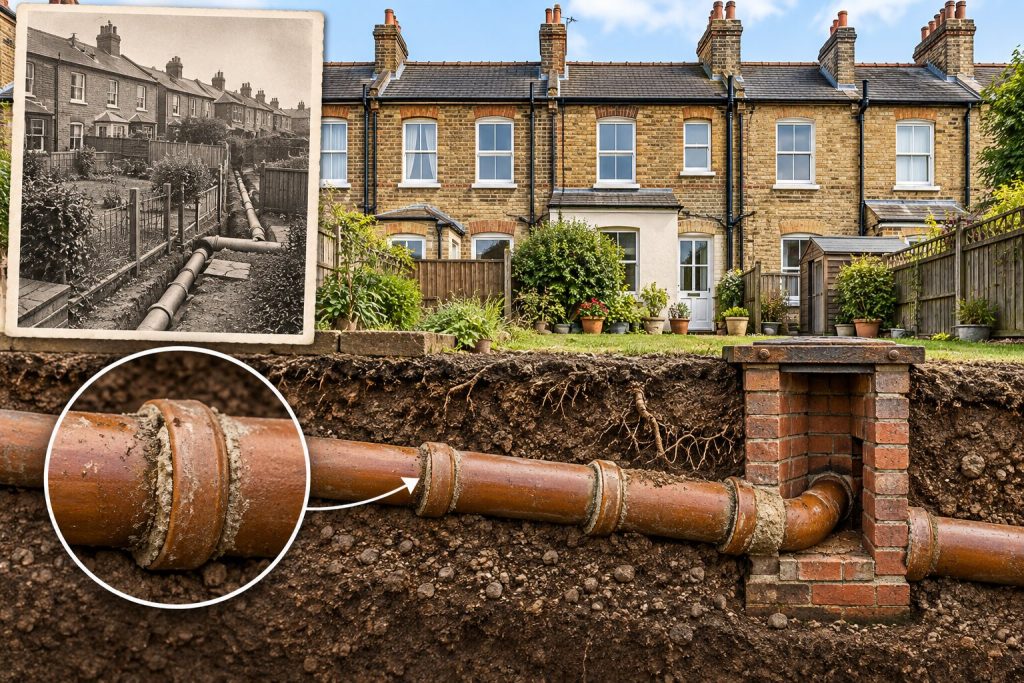
Most drainage installed between roughly 1850 and 1910 used vitrified clay pipe, typically 100mm or 150mm in diameter, joined with cement mortar in a socket-and-spigot arrangement. It was sound engineering for its time—clay is naturally resistant to corrosion, and the system was designed to last decades.
The layout, though, reflects the priorities of the era. Many Victorian terraces and semis share drainage runs with neighbouring properties, with a single pipe serving a row of houses across rear gardens before connecting to the public sewer. Inspection chambers were built in brick with iron covers, often tucked under later extensions, patio slabs, or—as our engineers regularly discover—forgotten beneath rather impressive rose beds.
Over the decades, the original system gets added to. Downstairs bathrooms, kitchen extensions, external taps, and various DIY connections all find their way onto pipes that were never designed to carry them. The clay joints that worked well in 1895 have now been dealing with ground movement, tree roots, and temperature cycling for well over a century.
Common problems in Victorian sewer pipework—and why Kent homes see them a lot
Victorian sewer pipe problems follow a fairly predictable pattern, and if you own a period property in Kent, at least one of these will be familiar.
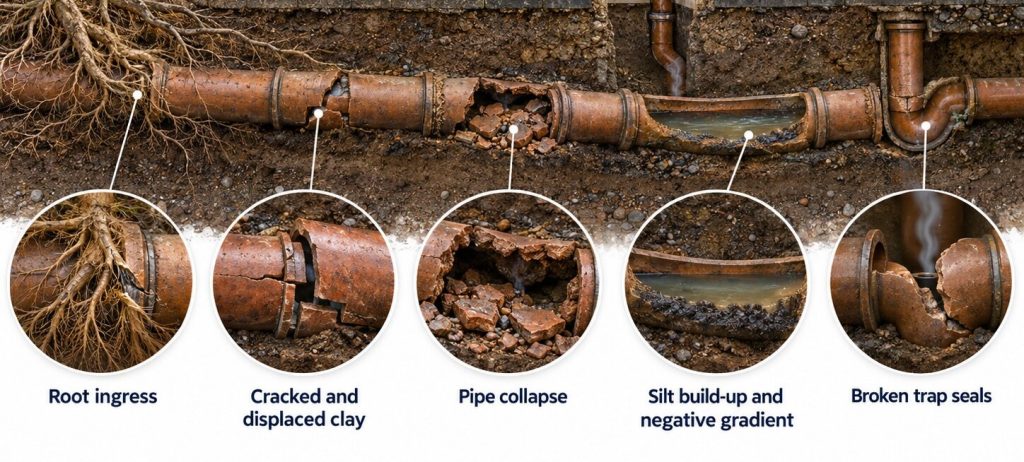
Root ingress is the most frequent culprit. Cement-mortar joints shrink and crack over time, creating tiny entry points that tree roots—particularly from mature oaks, limes, and plane trees common in older Kent gardens—find irresistible. Once inside, roots thicken, catch grease and tissue, and cause blockages that keep coming back no matter how many times you clear them.
Cracked and displaced clay develops from ground movement. As soil shifts with the seasons, individual pipe sections settle unevenly. A displaced joint of even 20–30mm is enough to trap solids and slow flow significantly.
Pipe collapse is less common but serious when it happens. Sections that have cracked repeatedly, or that have lost the surrounding soil support through water ingress, can eventually fail entirely.
Silt build-up and negative gradient (where a section of pipe has effectively lost its downhill slope through subsidence) creates areas of standing water inside the pipe. These become magnets for fats, scale, and debris.
Broken trap seals lead to unpleasant odours rising from the system into the house—particularly in ground-floor toilets and older gully traps in the garden.
Misconnections from decades of ad hoc alterations mean some properties have surface water going where foul water should, or vice versa. This usually surfaces (literally) during heavy rain.
Tell-tale signs your period property drains need attention
Some signs are obvious; others are easy to dismiss until they get worse.
- Repeated blockages—especially when “it was cleared just a few months ago”
- Gurgling sounds from toilets or sinks when another fixture drains
- Multiple slow-draining fixtures at once (rather than just one sink)
- Persistent bad smells inside, or near inspection chambers outside
- Unusually lush or wet patches in the garden—particularly in a straight line
- Backing up after heavy rain
- Damp near the base of external walls adjacent to drainage runs
If your garden smells like it’s hosting a festival toilet, it’s time to investigate properly rather than hope it resolves itself.
What’s different about Victorian drainage systems in Kent?
Kent’s older housing stock spans a huge range—from terraced town houses in Maidstone, Tunbridge Wells, and Folkestone to Victorian semis and detached homes in Sevenoaks, Tonbridge, and the villages in between. What many share is a combination of mature tree coverage (great for the garden, tough on clay joints), varied ground conditions, and drainage systems that have often passed through multiple owners and several waves of “improvement.”
The county’s mix of clay-heavy soils in the Weald and more chalk-based ground in areas like the North Downs affects how pipes settle over time. Heavy winter rainfall adds to the load on combined drainage systems—where foul and surface water share a pipe—that were already running close to capacity in dry conditions.
DIY checks before calling anyone
There are a few safe, sensible checks worth doing first.
Locate your inspection chambers (often in the garden or under a cover near the house) and lift the lid carefully—standing water or obvious overflow is a clear signal something’s blocked or broken downstream. Note when problems tend to happen: after rain, after using the washing machine, or only after cooking suggests very different causes.
Stop pouring cooking fats down the drain. It sounds obvious, but warm fat sets like wax once it cools inside a pipe, and in cold clay pipes it happens faster than you’d think. Use sink strainers to catch debris.
Drain-clearing chemicals have their place for minor organic blockages, but they won’t fix root ingress, displaced joints, or collapsed sections—and poured repeatedly into fragile old clay, they can do more harm than good.
If you’re seeing sewage backing up, recurring problems in multiple fixtures, or you genuinely don’t know where your drainage runs, stop there and call in a professional.
The professional approach we use—and why it’s kinder to old pipes
CCTV drain surveys: the quickest way to stop guessing
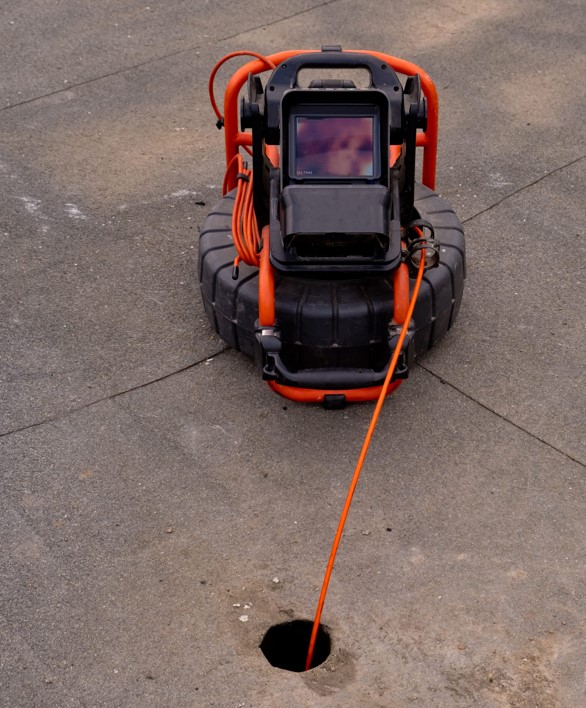
A CCTV drain survey sends a high-definition camera through your pipes and gives us a real-time view of exactly what’s happening underground. We can see root ingress, cracked sections, displaced joints, silt deposits, and misconnections—all without lifting a single paving slab. Our engineers are fully qualified, insured, and DBS checked, and after the survey you’ll get a clear explanation of what we found and what we recommend.
For period properties in Kent, a CCTV survey is almost always the right starting point. Guessing is expensive; knowing is efficient.
High-pressure water jetting
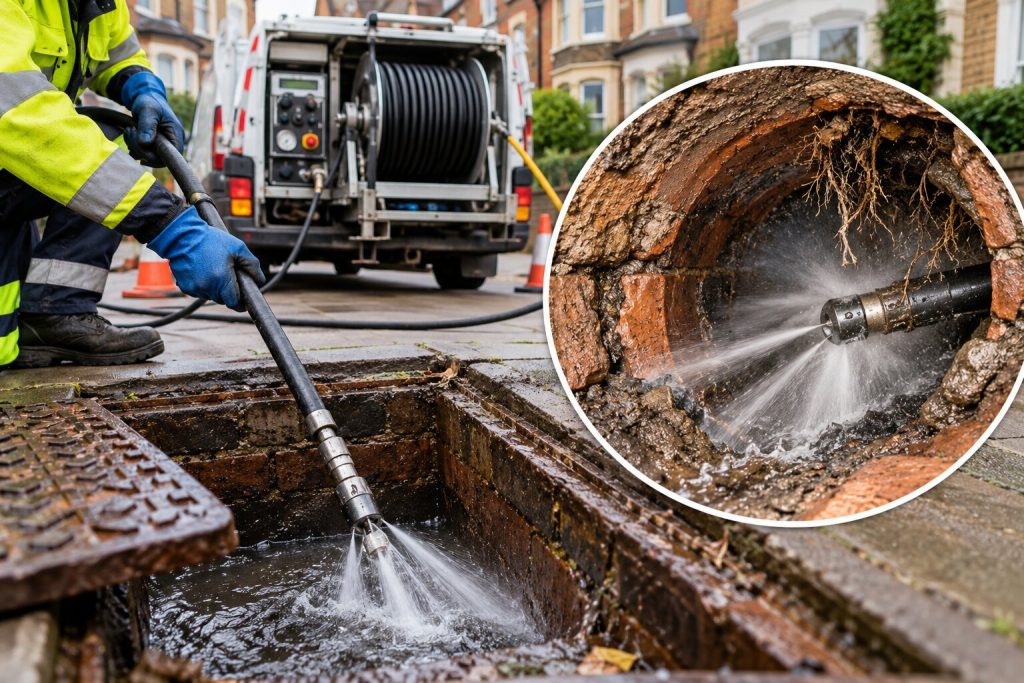
Where the pipe structure is sound, high-pressure water jetting is the most effective way to clear grease, scale, silt, and soft root material. It’s fast, thorough, and leaves the pipe considerably cleaner than when we arrived. It won’t, however, fix a collapsed section or a severely displaced joint—that needs a different approach.
Clay pipe drain repairs in Kent: repair vs replace
For isolated damage—a cracked section, a single displaced joint—a targeted point repair is usually sufficient. We excavate only what’s necessary, carry out the repair with premium materials, and leave the site tidy. Occasionally, where a section has collapsed entirely or access makes relining impractical, open excavation is the right answer, and we’ll always explain why before starting work.
Drain relining: a modern no-dig fix for a very old problem
Drain relining is one of the most useful developments for period property owners. A resin-saturated liner is inserted into the existing pipe and cured in place—creating a smooth, seamless internal surface that bonds to the host pipe and effectively gives you a new drain inside the old one.
It’s suitable for cracked pipes, minor displacement, and joints where roots have been cut back but the pipe is otherwise intact. The lined pipe resists future root ingress, improves flow, and carries a lifespan typically rated at 50 years. No excavation, no disruption to gardens or patios, and—for most runs—completed in a single day.
Maintaining older drainage without losing your weekend
The best maintenance for a Victorian system is preventative.
- A CCTV check every two to three years (more frequently if you’ve had repeated issues) catches problems while they’re still minor
- Be cautious about planting large trees close to existing drainage runs—mature roots and clay joints are an unhappy combination
- Never flush wipes (even those marketed as flushable), sanitary products, or cotton wool—old pipes have narrower tolerances than modern systems
- If you’re buying a period property in Kent, a homebuyer’s drain survey before exchange is a wise investment
When to call a specialist—and what to ask them
Call a drainage professional if you’re seeing sewage backups, persistent foul smells, repeated blockages that come back within weeks, visible damage to inspection chambers, or simply don’t know what your drainage looks like.
When you do, it’s worth asking:
- Can you carry out a CCTV survey and provide footage or a written report?
- Do you offer no-dig repairs such as relining?
- Are there call-out fees or weekend surcharges?
- Is the repair work guaranteed?
Frequently asked questions
Are Victorian clay drains always a problem?
Not necessarily. Clay is naturally durable, and a well-maintained clay system can still function effectively. The issues come from age-related joint failure, root ingress, and ground movement rather than the material itself. A CCTV survey will tell you exactly where yours stands.
How do I know if tree roots are in my drains?
The most common signs are recurring blockages that clear and then return, slow drainage from multiple fixtures, and gurgling sounds. A CCTV drain survey will confirm root presence and show the extent of ingress.
Is drain relining suitable for old clay pipes?
Yes, in most cases. Relining works well on cracked or slightly displaced clay pipes where the pipe still has enough structural integrity to hold the liner. We assess suitability as part of the CCTV survey before recommending any repair method.
Will you need to dig up my garden to fix a Victorian drain?
Not always. The majority of clay pipe repairs we carry out in Kent use no-dig methods—high-pressure jetting for blockages, CIPP relining for structural repairs. Excavation is reserved for collapsed sections or situations where access genuinely requires it.
What happens during a CCTV drain survey?
One of our engineers feeds a high-definition camera through your drainage system from an access point—usually an inspection chamber. The footage is recorded and reviewed in real time, identifying any defects, root intrusion, displaced joints, or blockages. You’ll receive a clear explanation of the findings and, if needed, a recommendation for repair.
Why do blockages keep coming back in older properties?
Recurring blockages usually point to a structural issue rather than a simple build-up. Root ingress, a displaced joint catching solids, or a negative gradient keeping water pooled in one section are the most common causes. Clearing the blockage temporarily relieves the symptom; fixing the underlying cause stops it returning.
Do you charge extra for weekend callouts in Kent?
No. We don’t charge extra for weekend work—if you need us, we’re there regardless of the day, and we won’t add a premium for it. No hidden fees, no surprise surcharges.
Do you offer guarantees on repairs and relining work?
Yes. All work comes with a written guarantee. We’re not in the habit of leaving until a job is done properly, and we stay in touch during aftercare to make sure everything continues to perform as expected.
Ready to find out what’s actually going on underground?
If you own a Victorian or Edwardian property in Kent and you’ve been dealing with slow drains, repeated blockages, odd smells, or just a general suspicion that something isn’t right, a CCTV drain survey is the clearest next step.
We cover the whole of Kent—from Ashford and Canterbury to Sevenoaks, Tonbridge, Tunbridge Wells, Maidstone, and beyond. Our engineers are fully qualified, DBS checked, and insured, and we’ll give you a straight explanation of what we find. There’s no call-out fee, and we’ll give you a free, no-obligation quote before any work begins.
Call us or book online.
You can also find out more about our CCTV drain surveys, drain relining, drain repairs, and blocked drain services across Kent.